 blog
How to Choose Virtual or In-Person Personal Training
Quick Summary
Virtual personal training is not automatically better or worse than in-person personal training. In-person training usually suits beginners and complex technique, while virtual training suits busy schedules and travel. Your choice depends on schedule, budget, and how much hands-on correction you need.
- Virtual sessions at Xtreme Advantage run live on Zoom, with direct trainer contact throughout the workout.
- Virtual sessions are 30 minutes long and can be booked with 12-hour notice.
- In-person training is usually the safer starting point for beginners during the first several weeks.
- Compare formats by monthly all-in cost, including travel, membership fees, and equipment, not session rate alone.
- Track sessions completed and a core strength number every four to six weeks to judge results.
Table of Contents
- Is Virtual Personal Training Better Than In-Person Training?
- Virtual vs In-Person Personal Training Pros and Cons
- Virtual vs In-Person Personal Training Cost in USD
- Do Virtual Personal Training Results Match In-Person Results?
- How Form Correction Works in Live Virtual Sessions
- Finding the Right Virtual Personal Trainer for You
- Booking Your First Session at Xtreme Advantage Personal Training
- Frequently Asked Questions
Is Virtual Personal Training Better Than In-Person Training?
Last Updated: November 23, 2026
Virtual personal training is not automatically better or worse than in-person training. Xtreme Advantage Personal Training offers both formats, so the right choice depends on your schedule, your budget, and how much hands-on correction you need. Our virtual sessions run live on Zoom, and you talk directly with your trainer throughout the workout. See what our virtual training program involves before you decide. The short answer: in-person training usually wins for beginners and complex technique, while virtual training wins for busy schedules and travel.
Personal training is a service where a coach designs and supervises your workouts. Whether you train in a studio or on a screen, the trainer's job is the same: build a plan, watch your form, and keep you accountable.
Many buyers focus only on price and convenience. Those matter, but they are not the whole picture. Read on to see where each format wins, what it costs, and how to decide.
Virtual vs In-Person Personal Training Pros and Cons
Each format has real strengths and real trade-offs. Neither one suits every goal.
Where virtual training wins
Virtual training removes the commute. You can train from home, the office, or wherever you are, which matters if you travel for work or have young children at home.
Scheduling is also more flexible. Our virtual training sessions are 30 minutes long, which fits into a lunch break or an early morning. Sessions can be booked on flexible on-demand scheduling with 12-hour notice.
Best for: busy professionals, parents, and anyone who has missed sessions at a gym before.
Where in-person training wins
In-person training gives your trainer a full view of your body and movement. Hands-on adjustments are easier to make face to face. Beginners and clients with specific health concerns often benefit from closer supervision. Anyone with a health condition should check with a qualified professional before starting.
In-person sessions also reduce distractions at home. Being in a dedicated training space helps many clients push harder.
Skip if: you have a hard time getting to a studio on a regular schedule.
Virtual vs In-Person Personal Training Cost in USD
Session price is the number most buyers compare first, but it is a poor number to compare in isolation. The format you choose changes several line items at once, and some of them are easy to overlook until they show up on a monthly statement.
The line items that actually differ
- Per-session rate. Session rates differ by format, and pricing depends on the trainer, session length, and package. Ask for the current rate in each format before comparing.
- Session length. A 30-minute virtual session and a 60-minute in-person session are not comparable on sticker price. Convert everything to a cost-per-hour figure before you decide.
- Membership or facility fees. Some studios charge a monthly membership or access fee on top of training. Ask directly whether a membership fee applies to your plan.
- Equipment. Virtual training may require equipment you do not already own, such as dumbbells, bands, or a bench. Ask what equipment a session needs before you start.
- Travel. Fuel, transit fares, parking, and rideshare add up over a month of twice-weekly sessions. This is a real cost of in-person training that almost never appears in a price list.
- App and platform subscriptions. Confirm whether any app or platform is part of the session price or a separate charge.
- Cancellation terms. Ask what the notice window and any cancellation terms are in each format.
How to build a fair monthly comparison
Use the same frequency and the same session length on both sides, then add the recurring extras. A simple worksheet:
- Sessions per month × cost per session.
- Add membership or facility fees.
- Add travel cost per trip × trips per month (in-person only).
- Add any app or platform subscription.
- Add the amortized equipment cost (total equipment spend divided by the number of months you expect to use it).
- Subtract anything the trainer includes, such as programming, check-ins, or nutrition guidance.
The format with the lower per-session rate is not always the lower monthly total, and the format with the higher per-session rate is not always the worse value once travel and membership fees are counted.
What to ask before you sign
Ask for the all-in monthly figure, not the session rate. Ask whether the rate changes with commitment length, whether sessions expire, and whether unused sessions roll over. Ask whether the trainer charges for the initial assessment. A trainer who answers these plainly is easier to budget around than one who quotes a single headline number.
Watch out: a low per-session rate paired with a mandatory monthly membership can cost more over time than a higher rate with no membership fee.
For current rates, package options, and any new-client offers, contact Xtreme Advantage Personal Training directly. Xtreme Advantage does not charge membership fees, and our virtual sessions are 30 minutes long.
The table below lists the cost line items that differ between the two formats, so you can compare them side by side.
| Cost item | Virtual | In-person |
|---|---|---|
| Session length | 30 minutes | Not stated in article |
| Membership or facility fee | Not stated in article | Some studios charge; ask directly |
| Equipment | May need dumbbells, bands, or a bench | Not stated in article |
| Travel | None | Fuel, transit, parking, or rideshare |
| Per-session rate | Varies; ask for current rate | Varies; ask for current rate |
Do Virtual Personal Training Results Match In-Person Results?
Most comparisons answer this with an opinion. A more useful answer separates what is actually measured from what is assumed, because the two formats differ in ways that matter for some outcomes and not others.
What the evidence generally shows
Research on remote and app-supported coaching generally finds that supervised exercise can produce meaningful improvements whether the supervision is in person or remote, provided the program is progressive and the client completes it. That is a general pattern, not a guarantee for any individual, and the quality of the studies varies.
Where in-person training retains an edge in the literature is in tasks that depend on precise external feedback: heavy compound lifts, Olympic lifts, and rehabilitation-adjacent movements where small positional errors carry real risk. Virtual training can suit general strength training, aerobic conditioning, mobility work, and habit-building, especially for clients who would otherwise skip sessions.
The mechanism, not the marketing
Results generally come from a program that progresses over time, enough weekly volume to drive adaptation, and consistent completion. Format affects the third input most. A client who trains consistently will usually progress better than one who misses many sessions. Virtual training can reduce the friction that causes missed sessions.
Format affects the first input least. A well-designed program is well-designed on a screen or in a studio. What changes is how quickly the trainer can correct a breakdown in technique before it becomes a habit.
Where the formats genuinely diverge
- Technique-heavy goals. In-person training can be better suited, because hands-on cueing and multiple viewing angles catch errors that a single camera angle may miss.
- Busy schedules and travel. Virtual wins, because a session that requires no commute is a session that happens.
- Beginners with no training history. In-person is usually the safer starting point for the first several weeks, until movement patterns are established.
- Experienced lifters with a solid base. Virtual is often sufficient, because the client can self-correct and the trainer's job shifts to programming and progression.
- Clients managing a health condition. Neither format replaces clinical care. A trainer should screen for red flags and refer out when a condition needs a physician or physical therapist.
How to judge your own results
Pick two or three measurable markers before you start: sessions completed per month, a strength number on a core lift, a waist or hip measurement, or a simple endurance test. Recheck them every four to six weeks. If sessions completed is high but the strength number is flat, the program needs adjusting. If the strength number is fine but sessions completed is low, the format is the problem, not the programming.
Read our CDC guidance on physical activity for adults for the general weekly activity targets that any program should be built around. Our clients who train remotely follow the same programming as in-person clients, and you can review client testimonials from past members to see how remote training has worked for others. Treat testimonials as anecdote, not evidence, and weigh them alongside your own tracked markers.
How Form Correction Works in Live Virtual Sessions
Form correction is the most common worry about virtual training. In a live session, your trainer watches you through the camera and gives verbal cues in real time. You can ask questions and adjust your position as you go.
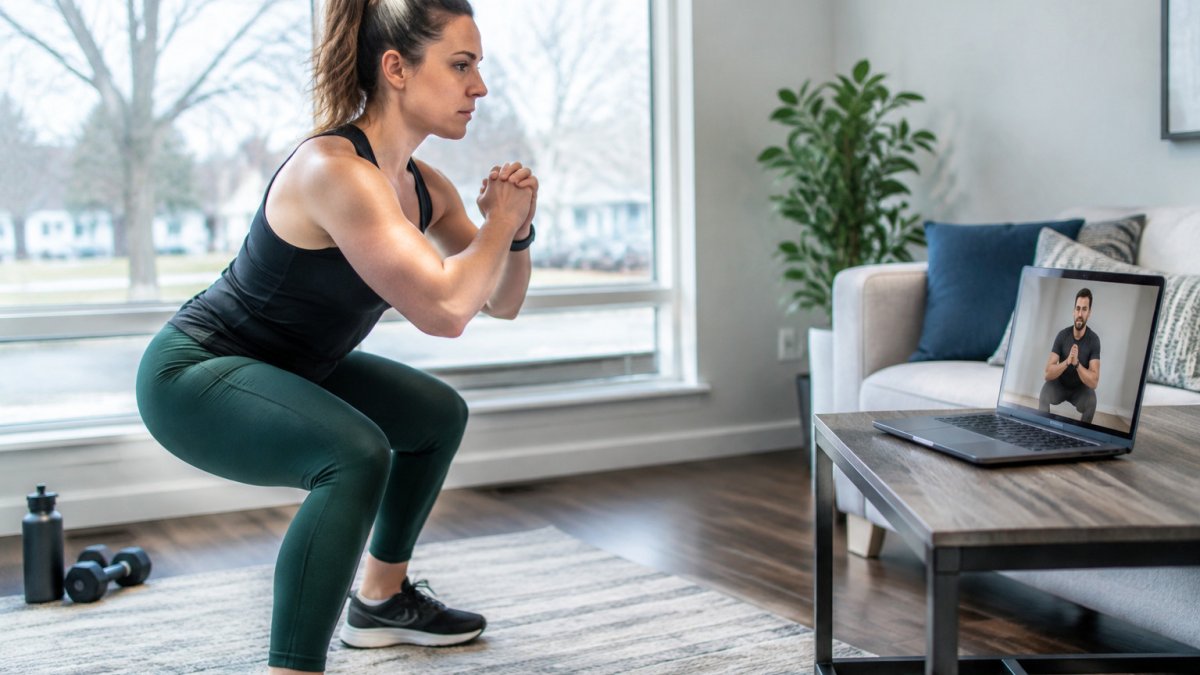
It helps to set up your space before the session begins. Place your device so your full body is visible, and keep enough room to move safely. A clear view makes corrections faster.
Finding the Right Virtual Personal Trainer for You
Look for a trainer with real experience, verifiable credentials, and a clear way of communicating. Ask how they monitor form, how they adjust programs, and how often they check in. A good trainer practices what they preach.
If you are still comparing options, this guide to studio-based alternatives explains how different trainers approach their work. Our rates are lower than most big box gyms, and our virtual sessions include live verbal coaching.
Booking Your First Session at Xtreme Advantage Personal Training
Ready to decide? Start by reaching out to our team with questions about format, scheduling, or your health history. You can also use our short contact form to request a first session. Whether you choose virtual or in-person, you will get a plan built around your goals.
Frequently Asked Questions
Does virtual personal training work?
Virtual personal training can work well when the program is structured, progressed over time and paired with consistent accountability. Live sessions over video allow a trainer to watch movement, cue technique and adjust exercises in real time. Results depend far more on consistency, sleep, nutrition and how closely you follow the plan than on whether sessions happen in person or online. Beginners and people with specific health conditions should check with a qualified professional before starting any new program.
Can a virtual personal trainer correct your form?
A virtual trainer can correct form during live video sessions, especially when the camera angle shows your full body from the side and front. Trainers can give verbal cues and suggest modifications immediately. Hands-on adjustments are not possible online, so in-person sessions may be more useful for complex lifts or when you are learning a new movement from scratch. Live feedback works best when you record your own sets for review between sessions.
How much do virtual personal trainers charge?
Pricing varies widely by trainer, session length and package size. Xtreme Advantage Personal Training does not charge membership fees, and its rates are lower than many big box gyms. For current virtual training pricing and new client offers, contact Xtreme Advantage Personal Training directly or visit its website for details. Compare the total monthly cost, not just the price per session, when weighing your options.
What equipment do you need for virtual personal training?
Most virtual sessions need only a smartphone, tablet or laptop with a camera, a stable internet connection and enough open floor space to move safely. Light dumbbells, resistance bands and a bench or sturdy chair expand the exercise options. Your trainer can suggest household substitutes if you do not own equipment. Using Zoom with direct verbal interaction, as Xtreme Advantage Personal Training does, keeps the session live and interactive.