 how-to
Customized Strength Training for Local Athletes
Table of Contents
- Why Customized Strength Training Matters for Athletic Performance
- Assessing Your Current Fitness Level and Training History
- Designing an Athlete Strength Training Program
- Sport-Specific Strength Training: Tailoring Exercises to Your Sport
- Youth Athlete Strength Training: Age-Appropriate Progression
- Building Your Strength Training Schedule for Athletes
- Measuring Progress and Preventing Injury
- Frequently Asked Questions
Last Updated: October 21, 2026
Why Customized Strength Training Matters for Athletic Performance
[Customized strength training](https://blog.xapersonaltraining.com/why-personal-training-is-worth-it) for local athletes isn't a luxury, it's the foundation of consistent performance gains. Generic programs miss what makes you different: your sport, your body, your goals, and your current fitness level.
Athletes who follow personalized programs progress faster than those on cookie-cutter routines. A program built for your sport addresses the exact movements and muscle groups you need, accounts for your injury history, and matches your schedule.
At Xtreme Advantage Personal Training & More, we offer customized strength training programs for local athletes. The difference between a generic workout and a customized strength training program for local athletes can be significant.
Assessing Your Current Fitness Level and Training History
Before you design anything, you need to know where you're starting.
A proper assessment for a customized strength training program covers six areas.
1. Sport, position, and competitive level. A goalkeeper and a wide receiver have different demands even though both play team sports.
2. Training history. How many years have you trained consistently, and with what methods, bodyweight, machines, barbells, Olympic lifts, plyometrics?
3. Injury history and current limitations. List every injury, even old ones.
**4.
5. Schedule and recovery capacity. Count your realistic training hours per week, your sleep, your school or work load, and your practice and competition commitments.
6. Goals and priorities. Rank what matters most right now: raw strength, power, speed, muscular endurance, injury resilience, or body composition.
Once you have those six inputs, translate them into program decisions:
- Exercise selection: choose compound patterns that match your sport's demands and modify movements that aggravate existing limitations.
- Volume and intensity: start at a level you can recover from given your schedule, then progress.
- Session frequency: match sessions to your available time and recovery capacity, not to an idealized template.
- Testing: pick two or three sport-relevant measures to re-test every four to six weeks.
An assessment is not a medical evaluation. If you have sharp pain, a recent injury, or a diagnosed condition, get cleared by a licensed healthcare provider first. A strength coach can design around a limitation, but only a medical professional can diagnose or treat one.
A customized program starts with a written assessment of sport, history, movement quality, schedule, and goals. Skip the assessment and you're guessing, and guessing is what generic programs do.
Designing an Athlete Strength Training Program
A real athlete strength training program has structure, not random exercises thrown together. Start with your primary goal, raw strength, power, muscular endurance, or injury prevention. Most athletes need a mix, but one should lead.
Next, identify the compound lifts that matter for your sport:
- Squats and leg presses build lower body strength
- Bench press and shoulder press develop upper body power
- Deadlifts strengthen the posterior chain
- Rowing movements build back strength and balance
- Olympic lifts (cleans, snatches) develop explosiveness
Your customized strength training for local athletes plan should include two to three compound movements per session as the foundation, with accessory work after. Then add sport-specific exercises, a soccer player needs different supplemental work than a baseball player.
Progressive overload is non-negotiable. Each week, lift slightly more weight, do more reps, or reduce rest periods. Without progression, you plateau, so track it.
| Element | Purpose | Frequency |
|---|---|---|
| Compound lifts | Build foundational strength | 2-3x per week |
| Sport-specific work | Address athletic demands | 1-2x per week |
| Accessory exercises | Target weak points | 1-2x per week |
| Progressive overload | Drive adaptation | Every session |
The best athlete strength training program is one you'll actually follow. Complex beats simple only if you stick with it.
Sport-Specific Strength Training: Tailoring Exercises to Your Sport
Here's where customized strength training for local athletes becomes real. Generic strength training helps. Sport-specific training transforms performance.
A basketball player needs explosive vertical power: plyometrics, single-leg work, and rapid force development. A baseball pitcher needs rotational power and shoulder stability: anti-rotation exercises, shoulder mobility, and explosive trunk movements.
Consider these sport-specific adjustments:
- Basketball: Add box jumps, single-leg squats, and lateral bounds
- Soccer: Include lateral lunges, lateral bounds, and high-rep lower body work
- Baseball: Emphasize rotational exercises, shoulder stability, and explosive hip extension
- Football: Build heavy lower body strength with squats and deadlifts, add lateral agility work
- Swimming: Focus on shoulder strength, core stability, and pulling power
- Track and field: Develop explosive power with Olympic lifts and plyometrics
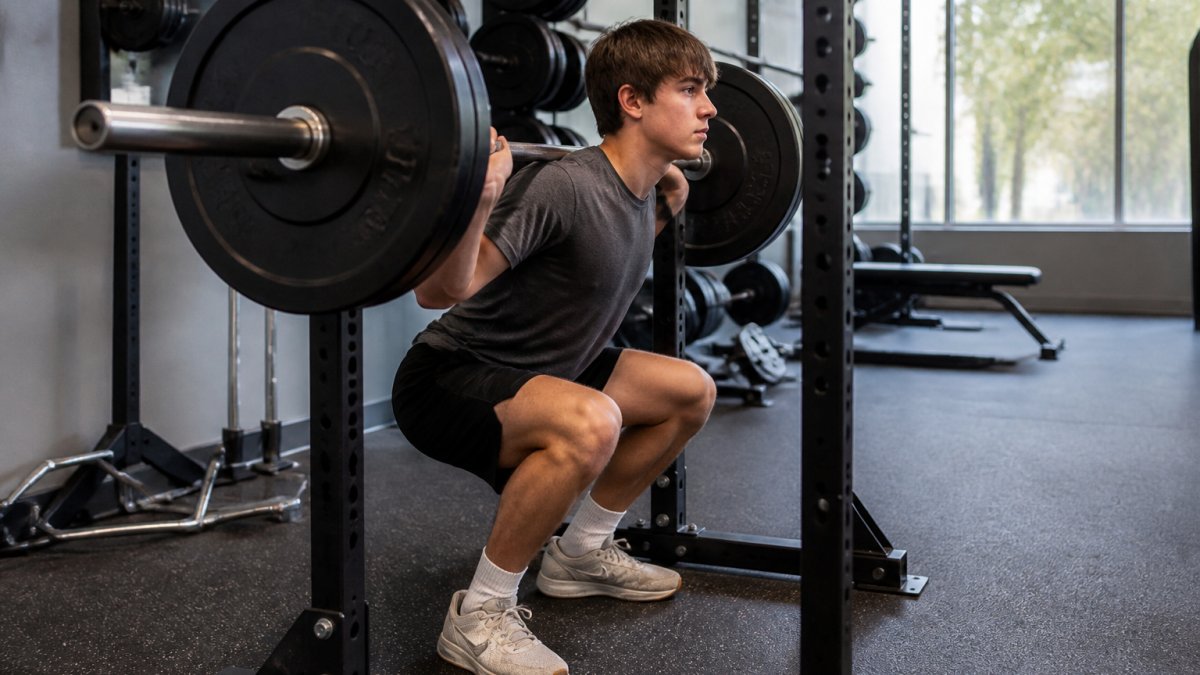
Movement quality matters more than load. A perfectly executed squat at moderate weight beats a sloppy squat with heavy weight. Your customized strength training program should include form checks and technique work before adding load. (Source: guidelines for conducting fitness assessments)
Youth Athlete Strength Training: Age-Appropriate Progression
Youth athletes need different approaches than adults: their bodies are still developing, their connective tissues are softer, and their recovery capacity is lower. Younger athletes respond quickly to proper training, but improper training causes lasting damage.
For youth athletes under 15, focus on movement quality and bodyweight exercises first:
- Bodyweight squats and lunges
- Push-ups and modified pull-ups
- Planks and core stability work
- Basic Olympic lift technique with PVC pipe or light bars
- Plyometric work (box jumps, bounds) with proper landing mechanics
Light resistance with perfect form beats heavy resistance with poor form. At this age, you're building movement patterns and work capacity, not maximal strength.
Ages 15-18 can add progressive resistance:
- Barbell back squats and deadlifts with light to moderate weight
- Bench press and overhead press
- Olympic lift variations
- Single-leg and single-arm work
- Sport-specific power development
Recovery matters more for youth athletes: adequate sleep, proper nutrition, and rest between sessions. A customized strength training for local athletes program for youth should never exceed four sessions per week.
Building Your Strength Training Schedule for Athletes
Your weekly schedule determines whether your program works or fails. A perfect program you skip is worse than a good program you follow. Start with your realistic available time:
- 3 sessions per week: 45-60 minutes each
- 4 sessions per week: 45-50 minutes each
- 5 sessions per week: 45 minutes each
A sample three-day split for customized strength training for local athletes:
Day 1 - Lower Body & Power
- Barbell back squat: 4 sets of 5 reps
- Box jumps: 4 sets of 3 reps
- Romanian deadlifts: 3 sets of 8 reps
- Leg curl: 3 sets of 10 reps
Day 2 - Upper Body & Pressing
- Bench press: 4 sets of 5 reps
- Barbell rows: 4 sets of 5 reps
- Overhead press: 3 sets of 6 reps
- Pull-ups: 3 sets of max reps
Day 3 - Full Body & Sport-Specific
- Deadlift: 3 sets of 3 reps
- Lateral bounds: 3 sets of 5 per side
- Single-leg squats: 3 sets of 5 per leg
- Sport-specific conditioning
Rest days matter, muscles grow during recovery, not training. Keep at least one rest day between sessions to prevent overtraining.
Measuring Progress and Preventing Injury
You can't improve what you don't measure. Tracking progress keeps you motivated, reveals when your program needs adjustment, and confirms training is actually working.
Pick sport-relevant tests, not generic ones. The best measures are repeatable, low-cost, and connected to your sport. Choose two or three from this list and re-test them on a consistent schedule:
- Sprint speed: a 10-yard and 40-yard dash for field and court athletes; a flying 20 or 30 for track sprinters. Use the same surface, timing method, and rest between attempts each time.
- Jump performance: a vertical jump (countermovement or standing) for basketball, volleyball, and football; a broad jump for general lower-body power. Measure with a consistent method, a jump mat, a Vertec, or a wall mark, and record the best of three attempts.
- Strength benchmarks: a estimated one-rep max or a rep-max test on a key lift (for example, a 5-rep back squat or a 3-rep trap-bar deadlift). Estimate from a submaximal set rather than testing a true max unless you have a qualified spotter.
- Workload tolerance: total weekly training minutes, number of high-intensity sessions, and how you feel on a simple 1-10 readiness scale. Sudden spikes in workload are a common precursor to soreness and overuse issues.
- Sport-specific capacity: repeated-sprint ability for soccer and lacrosse, change-of-direction time for court athletes, or throwing-volume tolerance for overhead athletes.
Test on a schedule, not constantly. Test every four to six weeks during a training block, plus a baseline at the start and a re-test at the end of each phase.
Track the basics every session. Log the weight, reps, and sets on your main lifts, your rest periods, and any pain or soreness notes. A simple notebook or spreadsheet is enough. The pattern over weeks matters more than any single session.
Injury prevention is about load management and movement quality. Most overuse problems come from doing too much, too soon, with too little recovery. Practical safeguards:
- Progress one variable at a time, weight, reps, or volume, not all three at once.
- Keep one full rest day between hard sessions, and schedule a lighter week every fourth week.
- Warm up dynamically before training and cool down with easy movement and static stretching afterward.
- Prioritize sleep (seven to nine hours for most athletes) and consistent nutrition and hydration.
- Address movement limitations early, a stiff ankle or unstable shoulder shows up in the weight room before competition.
Know the referral boundaries. A strength coach can design training, teach technique, and manage workload, but cannot diagnose an injury, prescribe rehabilitation, or clear an athlete to return to play.
Training through sharp pain doesn't build toughness, it builds injury. Soreness and fatigue are normal. Pain is not. Know the difference, and refer out when the problem is medical rather than programming.
Measure two or three sport-relevant tests every four to six weeks, log your main lifts every session, and manage load before it manages you. Progress you can measure is progress you can trust, and knowing when to refer to a medical professional is part of smart programming.
Frequently Asked Questions
How should athletes customize a strength training program?
Start by assessing your current fitness level, sport demands, and performance goals. Work with a coach or trainer to identify your sport's key movement patterns, a soccer player needs explosive leg power, while a swimmer benefits from shoulder and core stability. Your customized strength training program should include compound exercises (squats, deadlifts, presses) matched to your sport, a realistic weekly schedule that doesn't conflict with practice, and progressive overload to continuously challenge your muscles. Track your baseline metrics and adjust every 4-6 weeks based on results.
How many days a week should an athlete strength train?
Most athletes benefit from 2-4 strength training sessions per week, depending on your sport, current fitness level, and competition schedule. During off-season, 3-4 days allows deeper work. During competition season, 2-3 days maintains strength without interfering with sport-specific practice. Each session should target different muscle groups or movement patterns to allow recovery. A coach can help you structure your strength training schedule to complement your sport's demands and avoid overtraining.
Can young athletes do strength training?
Yes. Youth athlete strength training is safe and effective when done with proper technique and age-appropriate progression. Children as young as 7-8 can start with bodyweight exercises and light resistance, focusing on movement quality and learning correct form. Teenagers can progress to heavier weights under supervision. The key is working with a qualified coach who understands youth development, ensures proper technique before adding load, and avoids excessive weight that compromises form. Always prioritize movement quality over heavy weight.
How long does it take to see results from strength training?
Most athletes notice improved strength and power within 4-6 weeks of consistent, customized training. Movement quality and technique improvements often appear within 2-3 weeks. Visible muscle development typically takes 8-12 weeks. Performance gains, faster sprint times, higher jumps, increased throwing velocity, depend on your sport and baseline fitness but usually show within 6-8 weeks. Consistency matters more than intensity; missing workouts delays progress significantly. Regular progress tracking helps you stay motivated and adjust your program when results plateau.