 how-to
Is Personal Training Worth It for Weight Loss in Roseville?
Last Updated: October 31, 2026
Quick Summary
Personal training weight loss programs are worth it if you will actually show up and stick with the plan. A certified trainer starts with an assessment, designs workouts that combine strength and interval training, and adjusts your plan as your body changes.
- Start with an assessment covering your health history, activity level, and goals before any exercise begins.
- Train three days a week with full-body strength sessions and one interval day.
- Use double progression: add weight only after completing the top of the rep range with clean form.
- Choose one-on-one, small-group, or virtual formats based on your needs, budget, and schedule.
- Compare programs on total monthly cost rather than per-session price.
Table of Contents
- How Personal Training for Weight Loss Works
- Personal Training for Beginners: Starting Without Feeling Judged
- A Practical Weight Loss Workout Plan You Can Start This Week
- One-on-One, Small-Group, or Virtual: Which Format Fits Your Schedule
- Personal Training and Nutrition Guidance: What to Expect
- What Personal Training Costs in Roseville and How to Budget for It
- Booking Your First Session at XTREME Advantage
- Frequently Asked Questions
Is personal training worth the money if your goal is losing weight? For many people, the answer depends on whether they will actually show up and stick with the plan. This guide walks through how personal training for weight loss works, what affects its cost, and how to decide whether it fits your life. Personal training weight loss is a structured program where a certified trainer designs workouts, tracks your progress, and adjusts your plan as your body changes.
How Personal Training for Weight Loss Works
A good weight loss program starts with an assessment, not a workout. Your trainer should ask about your health history, current activity level, and goals before any exercise begins. Many people with weight-related health concerns also want to know how exercise affects blood pressure and energy, so those questions belong in the first session.
Sessions typically combine strength training with higher-intensity intervals. Strength work builds lean muscle, which supports a healthier metabolism over time. Explore the boot camp program to see how sessions are structured. Interval work raises your heart rate and burns more energy during the session.
Expect your trainer to watch your form closely. Correct technique reduces injury risk and makes the work more effective. Watch out: going too hard in the first few weeks is a common reason people quit. A trainer's job is to pace you so you can keep showing up.
Personal Training for Beginners: Starting Without Feeling Judged
Many beginners avoid gyms because they fear being compared to everyone else. Personal training removes much of that pressure. You train one-on-one or in a small group, with a coach focused entirely on your starting point.
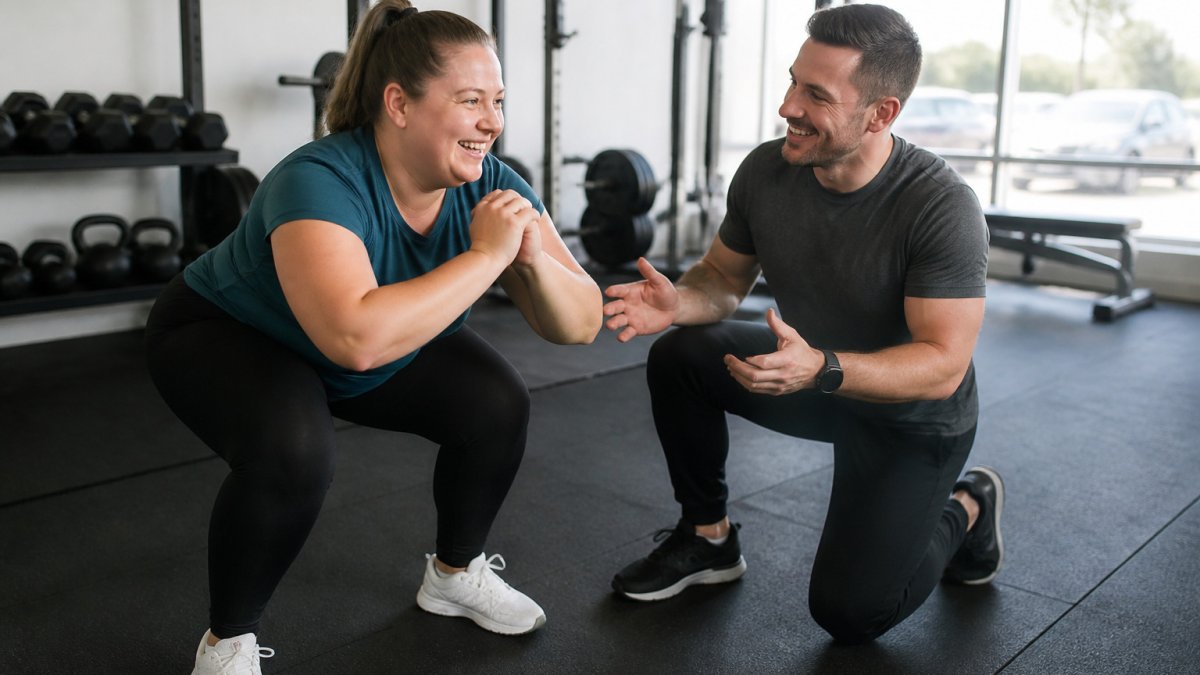
Beginners tend to do best when they set small, specific goals for the first month. Instead of "lose 30 pounds," try "complete three training sessions per week and learn six basic movements." Early wins build confidence.
Tell your trainer what makes you uncomfortable. A good coach will modify exercises rather than push you past your limits.
A Practical Weight Loss Workout Plan You Can Start This Week
Here is a sample eight-week personal training weight loss structure you can bring to a first session or run on your own between sessions. It assumes three training days and two to three easy activity days per week, which is a common starting point for beginners.
Weekly template
- Day 1, Full-body strength A: Goblet squat, dumbbell row, incline push-up, hip hinge (Romanian deadlift with dumbbells), plank. Two to three sets of 8-12 reps.
- Day 2, Intervals: Five-minute easy warm-up, then 6-8 rounds of 30 seconds of brisk walking, cycling, or rowing at a pace where talking is difficult but possible, followed by 90 seconds of easy recovery. Cool down five minutes.
- Day 3, Full-body strength B: Reverse lunge, chest press, lat pulldown or band pull-down, glute bridge, dead bug. Two to three sets of 8-12 reps.
- Days 4-7, Easy activity: Two or three 20-30 minute walks, plus one full rest day. Walking is the recovery tool, not a punishment.
How to progress without stalling
Use a simple double-progression rule: stay at the same weight until you can complete the top of the rep range on every set with clean form, then add the smallest available increment (typically 2.5-5 lb for upper body and 5-10 lb for lower body) and drop back to the bottom of the rep range. This is the mechanism most trainers use to keep beginners moving forward without guessing.
Realistic milestones
- Weeks 1-2: Show up for all scheduled sessions and learn the six to eight core movements. No load increases required.
- Weeks 3-4: Add one set to each strength exercise if recovery feels good, and extend intervals to 8-10 rounds.
- Weeks 5-6: First load increases on two or three lifts; add a third walk day.
- Weeks 7-8: Re-test the same movements at the same reps and compare weights, reps, and how the effort felt. Individual results vary widely during this window.
What to track each session
Log the exercise, weight, reps per set, and a one-word effort rating (easy, moderate, hard). Bring that log to your trainer or review it yourself weekly. If effort is "hard" on every set for two weeks straight and sleep or mood is slipping, cut one set rather than adding load, that is the adjustment a good coach would make.
This plan is a starting framework, not a prescription. If you have joint pain, a history of injury, or a managed chronic condition, have a qualified trainer or your healthcare provider review the movements before you load them.
One-on-One, Small-Group, or Virtual: Which Format Fits Your Schedule
The format you choose shapes how often you train and how much attention you get.
| Format | Best For | Key Benefit |
|---|---|---|
| One-on-one | Beginners, health concerns, plateaus | Full attention on your form |
| Small-group (up to three clients) | Motivation and social support | Lower cost per session |
| Virtual live training | Busy professionals, travelers | Train from home with live feedback |
Virtual training through Zoom includes direct verbal interaction, so your trainer can still correct your form on camera. You can see how to book a virtual session around your schedule. Flexible scheduling with 12-hour notice makes it easier to keep sessions when work runs late.
Personal Training and Nutrition Guidance: What to Expect
Exercise alone rarely produces lasting weight loss. Most results depend on consistent eating habits, so ask whether nutrition guidance is part of the package. Personal training programs can include customized nutritional guidance alongside training, focused on realistic changes like protein at each meal and fewer liquid calories. Our personalized nutrition plans guide explains what this support looks like.
Be cautious of any program promising rapid results from a strict diet. Sustainable weight loss usually comes from a modest, consistent calorie deficit. If you take medication or have a medical condition, check with your doctor before major dietary changes.
What Personal Training Costs in Roseville and How to Budget for It
Pricing varies by format, frequency, and package length. Contact the studio directly for current prices and any available discounts. Our Roseville affordability guide walks through budgeting options in more detail. What you can do right now is build a realistic budget and compare formats on total cost rather than headline rate. Discounts are available for military members, first responders, and seniors, so ask about eligibility before you compare packages.
A budgeting framework that works
- Set a monthly ceiling first. Decide what you can spend every month for at least three months without touching savings. Consistency matters more than the per-session rate.
- Divide by sessions. If your ceiling is a fixed monthly amount, divide it by the number of sessions you can realistically attend. Two sessions per week is a common starting frequency; one session per week plus a self-guided plan is a lower-cost alternative.
- Compare total monthly cost, not per-session price. A cheaper session you attend once a month costs more per unit of progress than a pricier session you attend eight times.
- Audit existing spend. Add up gym memberships, app subscriptions, and class packs you rarely use. Redirecting that money is often the difference between affording one-on-one and not.
- Ask about introductory offers. Many trainers offer a trial session, a movement assessment, or a short starter package. Use it to evaluate fit before committing to a longer block.
Format cost trade-offs at a glance
| Format | What drives the price | Best value when |
|---|---|---|
| One-on-one | Trainer's undivided time | You need form correction or have health considerations |
| Small-group (up to three) | Split trainer time | You want accountability at a lower per-person rate |
| Virtual live | Lower facility overhead | Travel time or schedule is your main barrier |
| In-home | Travel and equipment | Convenience outweighs cost |
Questions to ask before you sign
- What is the per-session rate at each block size, and is there a cancellation policy?
- Are sessions reschedulable, and with how much notice?
- Is nutrition guidance included, or is it a separate fee?
- Are there discounts for military, first responders, or seniors, and how do I qualify?
- What happens if I need to pause for an injury or travel?
Getting answers to these five questions in writing lets you compare any local option on equal footing, even when published rates are not available.
Booking Your First Session at XTREME Advantage
If you are ready to try personal training for weight loss, start with a consultation so your trainer can build a plan around your goals and schedule. Reach out to ask about one-on-one, small-group, or virtual options and to book your first session. Use the short contact form to request a session in under a minute.
Frequently Asked Questions
Can a personal trainer help me lose weight?
Yes. A personal trainer helps you build a structured exercise routine, adjusts intensity as you improve, and checks your form so you can train consistently without injury. Weight loss depends on calorie balance, so trainers at XTREME Advantage pair workouts with nutritional guidance rather than exercise alone. Results vary by starting point, consistency and sleep, and anyone with a medical condition such as high blood pressure should get cleared by a doctor before starting a new program.
How often should I work with a personal trainer to lose weight?
Many people start with two sessions per week and add home or independent workouts on the other days. Two sessions give you enough structure to build habits and receive corrections on form, while the remaining days let you apply what you have learned. Your schedule, fitness level and budget should guide the exact frequency, and XTREME Advantage can help you find a rhythm that fits a busy week.
Is one-on-one or small-group personal training better for weight loss?
One-on-one training gives the most individual attention on form, pacing and health considerations. Small-group training, which at XTREME Advantage is limited to three clients, costs less per session and adds motivation from training alongside others. Beginners who want close correction often start one-on-one, then move to small groups once they are confident with the movements.
Do I need to be fit before starting personal training?
No. Personal training is designed for people at every fitness level, including those who feel out of shape or have health concerns such as blood pressure issues. A trainer will start with movements that match your current ability and progress them over time. Share your health history during your consultation so the program can be adapted safely to your needs.
Is personal training worth it? For people who struggle to start or stay consistent on their own, it often is. Take the first step by contacting us today and let's build a plan you can actually keep.